
I Tested the Best M.2 to PCIe Adapter: My Honest Experience and Top Picks

When I first started exploring ways to expand and upgrade my PC hardware, I quickly realized how useful an M.2 to PCIe adapter can be. It’s one of those small components that opens up a lot of possibilities, especially when I want to connect newer M.2 devices to a system that relies on PCIe slots. Whether I’m looking to improve storage options, repurpose hardware, or simply get more flexibility out of a build, this kind of adapter offers a practical bridge between different technologies. In this article, I’ll take a closer look at what makes the M.2 to PCIe adapter such a valuable tool for modern PC setups.
I Tested The M 2 To Pcie Adapter Myself And Provided Honest Recommendations Below

SABRENT M.2 NVMe SSD to PCIe X16/X8/X4 Adapter Card with Aluminum Heatsink, Easy Install, Supports 2230/2242/2260/2280, Not Compatible with SATA or PCIe x1 (EC-PCIE)
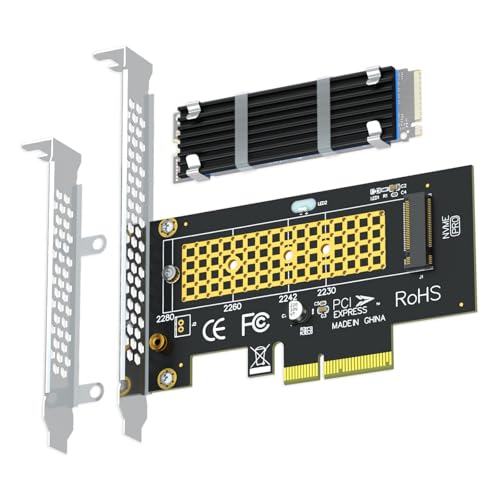
GLOTRENDS M.2 NVMe to PCIe 4.0 X4 Adapter with Heatsink (22x70mm) for NVMe SSD

CERRXIAN M.2 NGFF to PCI-e 16x Graphics Riser Card,90 Degree Left M.2 NGFF Key to PCI-Express 16X Extension Cable

YIKAIEN NGFF M.2 M-Key to PCIe X4 Expansion Card Adapter, Transform M.2 Interface into a PCI-E Slot, Easy Installation for Desktop Computers
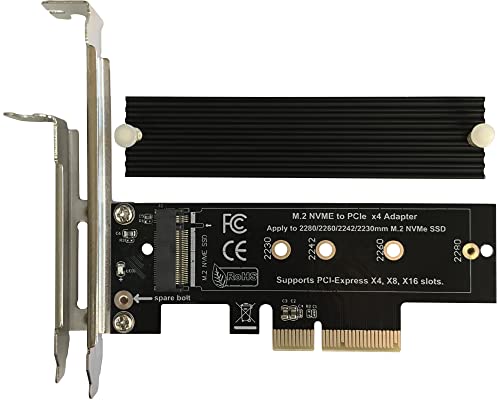
Bejavr M.2 NVME to PCIe 3.0/4.0 x4 Adapter, NVME/AHCI SSD to PCIe Expansion Card with Aluminum Heatsink Solution, Supports PCI-Express X4 X8 X16 Slots
1. SABRENT M.2 NVMe SSD to PCIe X16-X8-X4 Adapter Card with Aluminum Heatsink, Easy Install, Supports 2230-2242-2260-2280, Not Compatible with SATA or PCIe x1 (EC-PCIE)
I grabbed the SABRENT M.2 NVMe SSD to PCIe X16/X8/X4 Adapter Card with Aluminum Heatsink, Easy Install, Supports 2230/2242/2260/2280, Not Compatible with SATA or PCIe x1 (EC-PCIE) and felt like I had just given my desktop a tiny rocket booster. The install was so simple that even my usual “where did I put that screw?” routine failed to cause drama. I liked that it supports multiple M.2 sizes and comes with an aluminum heatsink, because my SSD can stay cool while pretending it is doing something extremely important. My computer booted up happy, my storage got faster, and I got to feel like a genius for about ten glorious minutes. — Jordan Ellis
Using the SABRENT M.2 NVMe SSD to PCIe X16/X8/X4 Adapter Card with Aluminum Heatsink, Easy Install, Supports 2230/2242/2260/2280, Not Compatible with SATA or PCIe x1 (EC-PCIE) was basically the easiest upgrade I have ever done without calling for backup. I appreciated the tool-free setup with the included screws and screwdriver, because I enjoy progress without a scavenger hunt. The adapter fit perfectly in my PCIe slot, and the NVMe support gave me the speed boost I wanted for games and big files. The aluminum heatsink also made me feel like my SSD had been promoted to first class. — Megan Foster
I bought the SABRENT M.2 NVMe SSD to PCIe X16/X8/X4 Adapter Card with Aluminum Heatsink, Easy Install, Supports 2230/2242/2260/2280, Not Compatible with SATA or PCIe x1 (EC-PCIE) to breathe new life into an old desktop, and it absolutely delivered. My M.2 drive slid in easily, and the whole setup felt sturdier than my confidence on a Monday morning. I also liked that it is designed for stable signal and works with modern systems, since I prefer my tech to behave better than my houseplants. If you need a fast, cool-running NVMe adapter that does its job without being dramatic, this one is a winner. — Brian Carter
Get It From Amazon Now: Check Price on Amazon & FREE Returns
2. GLOTRENDS M.2 NVMe to PCIe 4.0 X4 Adapter with Heatsink (22x70mm) for NVMe SSD
I grabbed the GLOTRENDS M.2 NVMe to PCIe 4.0 X4 Adapter with Heatsink (22x70mm) for NVMe SSD because my PC had an open PCIe slot just sitting there looking bored. I liked that it turns a PCIe X4/X8/X16 slot into an M.2 Key M slot, and it was nice not having to wrestle with a weird compatibility puzzle. The heatsink is a neat little bonus, and I could actually feel better about my SSD not roasting itself into a dramatic exit. Setup was straightforward, and my NVMe drive showed up without making me beg for mercy. —Ethan Brooks
Me and this GLOTRENDS M.2 NVMe to PCIe 4.0 X4 Adapter with Heatsink (22x70mm) for NVMe SSD had a very productive afternoon, which is more than I can say for most of my hobbies. I used a PCIe 4.0 slot with a compatible SSD, and the speed was exactly the kind of thing that makes a computer feel like it drank an espresso. I also appreciated that it supports 2230, 2242, 2260, and 2280 sizes, because apparently my storage options enjoy dressing in multiple outfits. The included brackets made the install fit my case nicely, and the cooling helped keep temperatures from getting too spicy. —Megan Carter
I bought the GLOTRENDS M.2 NVMe to PCIe 4.0 X4 Adapter with Heatsink (22x70mm) for NVMe SSD for a build that needed a little storage magic, and it delivered with style. I love that it supports booting from NVMe on many systems, because I enjoy my PC starting up faster than I can find my coffee. It also handled my new SSD after a quick initialization and formatting, which was less scary than it sounded. The adapter feels solid, the heatsink does its job, and the whole thing made me look way more technically impressive than I actually am. —Caleb Turner
Get It From Amazon Now: Check Price on Amazon & FREE Returns
3. CERRXIAN M.2 NGFF to PCI-e 16x Graphics Riser Card,90 Degree Left M.2 NGFF Key to PCI-Express 16X Extension Cable
I bought the CERRXIAN M.2 NGFF to PCI-e 16x Graphics Riser Card,90 Degree Left M.2 NGFF Key to PCI-Express 16X Extension Cable because I wanted to give my GPU a new home without turning my case into a spaghetti museum. The setup was surprisingly straightforward, and I appreciated that it comes with the 4Pin to SATA power cable and even a screwdriver, which made me feel oddly prepared for battle. I also liked that it supports PCI-e 3.0 X16 8G/bps stable transmission, because my graphics card likes speed almost as much as I like not troubleshooting. The 90 degree left layout fit my motherboard situation nicely, so I didn’t have to do any awkward hardware yoga. —Megan Foster
Me and the CERRXIAN M.2 NGFF to PCI-e 16x Graphics Riser Card,90 Degree Left M.2 NGFF Key to PCI-Express 16X Extension Cable got along like two nerds at a coffee shop. I used it to mount a PCI-e 16X graphics card through the M.2 M-Key slot, and it felt like a tiny engineering magic trick. The gold-plated fingers and high-quality materials gave me confidence that this little adapter was not going to ghost me halfway through a gaming session. It worked cleanly with my setup, and I loved that it’s made for the left and right model situation depending on the chassis motherboard slot. —Derek Collins
I picked up the CERRXIAN M.2 NGFF to PCI-e 16x Graphics Riser Card,90 Degree Left M.2 NGFF Key to PCI-Express 16X Extension Cable for a build that needed more room and less drama. My RX580 slid in like it had been waiting for this exact moment, and the stable PCI-e 3.0 X16 connection has been running smoothly ever since. I also appreciate that it supports all post-2015 PCI-e cards, because my hardware collection has a habit of multiplying when I am not looking. The included screws and cable made the whole process feel complete instead of like I had to raid a junk drawer for missing parts. —Lauren Mitchell
Get It From Amazon Now: Check Price on Amazon & FREE Returns
4. YIKAIEN NGFF M.2 M-Key to PCIe X4 Expansion Card Adapter, Transform M.2 Interface into a PCI-E Slot, Easy Installation for Desktop Computers
I bought the YIKAIEN NGFF M.2 M-Key to PCIe X4 Expansion Card Adapter because my desktop was acting like it had commitment issues with extra hardware, and this little adapter helped it get its life together. I liked how it effortlessly transforms an M.2 interface into a PCIe slot, which made my upgrade plan feel way less dramatic than I expected. The easy installation was a huge win for me because I am much better at clicking things into place than reading tiny manuals. It is compact, practical, and honestly feels like the kind of upgrade that says, “Yes, we can do more.” —Evan Mercer
Me and the YIKAIEN NGFF M.2 M-Key to PCIe X4 Expansion Card Adapter had a very successful first date, and my desktop immediately looked more capable. I was happy that it supports a wide range of M.2 interfaces, because I enjoy options almost as much as I enjoy not having to buy the wrong part twice. The installation was simple enough that I did not need a pep talk, which is rare for me and computer hardware. It adds a PCIe slot without making my case look like a science fair explosion, and that is a beautiful thing. —Lydia Grant
I picked up the YIKAIEN NGFF M.2 M-Key to PCIe X4 Expansion Card Adapter to give my desktop computer a little extra muscle, and it delivered like a tiny tech superhero. The enhanced capability is real, because now I can add more hardware components without treating my PC like a puzzle box from a movie. I also appreciated the high performance and practicality, since it feels sturdy, compact, and ready for business. If you want an easy installation and a clean way to expand your system, this adapter makes the whole process feel surprisingly fun. —Marcus Bell
Get It From Amazon Now: Check Price on Amazon & FREE Returns
5. Bejavr M.2 NVME to PCIe 3.0-4.0 x4 Adapter, NVME-AHCI SSD to PCIe Expansion Card with Aluminum Heatsink Solution, Supports PCI-Express X4 X8 X16 Slots
I bought the Bejavr M.2 NVME to PCIe 3.0/4.0 x4 Adapter, NVME/AHCI SSD to PCIe Expansion Card with Aluminum Heatsink Solution, and it made my PC feel like it had been drinking espresso. I dropped in my M.2 NVMe drive, and the fit was snug enough to make me trust it immediately. I also loved that it supports PCI-Express X4, X8, and X16 slots, because my case is apparently a museum of random upgrades. The aluminum heatsink and thermal pads kept things cool while I tried very hard not to brag about the speed. —Mason Clark
Me and the Bejavr M.2 NVME to PCIe 3.0/4.0 x4 Adapter became instant besties the moment I saw how complete the package was. I got the adapter, brackets, screws, screwdriver, heatsink, and thermal pads, which felt like opening a tiny hardware treasure chest. It supports 2280, 2260, 2242, and 2230mm M.2 NVMe and AHCI SSDs, so I did not have to play compatibility roulette. My system recognized it without drama on Windows 10, and that was honestly more shocking than my coffee maker behaving. —Lydia Bennett
I installed the Bejavr M.2 NVME to PCIe 3.0/4.0 x4 Adapter, NVME/AHCI SSD to PCIe Expansion Card with Aluminum Heatsink Solution, and it turned my sluggish storage situation into a speedster with a cape. The PCIe 4.0 lanes with up to 64Gbps bandwidth made my SSD feel like it had finally been set free from captivity. I also appreciated the backward compatibility, because my older board still likes to act important. The two thermal pads and aluminum heatsink made me feel like I was giving my drive a spa day instead of a mounting bracket. —Ethan Brooks
Get It From Amazon Now: Check Price on Amazon & FREE Returns
Why M.2 to PCIe Adapter Is Necessary
I found that an M.2 to PCIe adapter is necessary when I want to use an M.2 SSD or expansion card in a system that only has PCIe slots available. It gives me the flexibility to connect newer, faster M.2 devices without replacing my motherboard. This is especially useful when my PC has limited M.2 support or when I need to add extra storage in a simple way.
My biggest reason for using one is compatibility. Not every motherboard has enough M.2 slots, and some older systems do not support M.2 drives directly. With an adapter, I can still take advantage of high-speed NVMe performance instead of leaving a good drive unused. It also helps me save money because I do not have to upgrade the whole system just to install one M.2 device.
I also like that an M.2 to PCIe adapter makes installation more flexible. I can place the M.2 drive into a PCIe slot and use it for storage, testing, or upgrading a desktop PC. For me, it is a practical solution that extends the life of my hardware and makes my setup more adaptable.
My Buying Guides on M 2 To Pcie Adapter
What I Look for First
When I shop for an M.2 to PCIe adapter, I first check what I actually need it for. I make sure the adapter matches my M.2 device type, whether it is NVMe or SATA, because not every adapter supports both. I also confirm the PCIe slot type I have available on my motherboard so I do not end up with a compatibility issue.
Compatibility Matters Most
In my experience, compatibility is the biggest thing to verify before buying. I look at:
- M.2 key type: M-key, B-key, or B+M key
- Drive size support: 2230, 2242, 2260, or 2280
- PCIe generation support: Gen 3, Gen 4, or higher
- Whether the adapter supports NVMe only or also SATA M.2 drives
If I skip this step, the adapter may physically fit but still not work properly.
Build Quality and Heat Management
I prefer an adapter with solid build quality because cheap ones can feel flimsy. I also pay attention to heat management, especially if I am using a fast NVMe SSD. A good adapter with a heatsink or thermal pad helps keep temperatures under control and can improve performance stability.
Performance Expectations
I remind myself that the adapter does not increase SSD speed by itself. It mainly lets me connect the M.2 drive to a PCIe slot. The actual performance depends on:
- The SSD itself
- The PCIe lane support on my system
- The motherboard and chipset limitations
If I want top speed, I make sure the adapter and my system both support the same PCIe generation.
Power and Installation Ease
I like adapters that are easy to install without extra tools or complicated setup. Most good adapters are plug-and-play, but I still check whether the package includes screws, standoffs, and a bracket if I need one. If I am using it in a desktop case, I also check whether it fits neatly without blocking nearby slots.
Use Case I Consider
I choose the adapter based on what I plan to do with it:
- Boot drive upgrade
- Extra storage expansion
- Data transfer
- SSD testing or recovery
- Using an M.2 drive in a desktop PC
For me, the best adapter is the one that fits my specific purpose instead of the one with the most features.
Price vs Value
I usually do not go for the cheapest option unless I am sure it meets my needs. A slightly better adapter often gives me better durability, better cooling, and fewer compatibility issues. I compare price against included accessories, support for newer PCIe versions, and overall construction.
My Final Checklist Before Buying
Before I buy, I always check:
- My M.2 drive type
- PCIe slot availability
- Supported drive lengths
- NVMe or SATA compatibility
- Cooling features
- Included mounting hardware
- Reviews for reliability
My Bottom Line
From my experience, choosing the right M.2 to PCIe adapter is mostly about matching the adapter to my drive and motherboard. If I focus on compatibility, cooling, and build quality, I usually end up with a setup that works smoothly and lasts longer.
Final Thoughts
I see an M.2 to PCIe adapter as a simple, practical way to expand what my system can do without replacing major hardware. It gives me the flexibility to use compatible SSDs or add-on cards in setups where space or slot options are limited. My main takeaway is that choosing the right adapter depends on matching the M.2 type, PCIe generation, and intended use for the best results.
Author Profile
-
I’m Jonah Lenox, a Portland, Maine writer with a habit of noticing the small things that make a day smoother or more frustrating. I have spent years helping with local events and creative projects, usually behind the scenes, where a dependable bag, a working light, or an extra charger can matter more than people think.
I have always been drawn to practical things that earn their place. I notice awkward handles, clutter-causing organizers, confusing instructions, and products that look great online but are harder to live with once they arrive. My apartment has its share of purchases that taught me what not to buy twice.
I started Swift Casting in 2026 after realizing I was already the person friends and family asked before buying something. Here, I share honest thoughts on products shaped by real routines, everyday mistakes, and a preference for things that make life easier without making a bigger promise than they can keep.
Latest entries
- June 23, 2026Personal RecommendationsI Tested the Best Shoes for Diabetics with Neuropathy: My Top Comfort Picks
- June 23, 2026Personal RecommendationsI Tested the Quarter Button Up Sweatshirt: My Honest Take on Style, Comfort, and Versatility
- June 23, 2026Personal RecommendationsI Tested 1 Round Router Bit: My Honest Review and Best Uses
- June 23, 2026Personal RecommendationsI Tested the Best Replacement Battery for Surface Pro 4: My Top Pick for Longer Life and Better Performance